Rigor Vitae: Life Unyielding

Wednesday, May 31, 2006

A PINEDALE ANTICLINE PHOTOJOURNAL--Part II: The Raptors

Last year's exceptional rains nurtured a spectacularly successful generation of wildlife that has come back to roost (and nest) this year. It's hard to believe the current density of raptor nests on the Pinedale Anticline. Golden Eagles (Aquila chrysaetos) are the top predator of the area, but are plentiful nonetheless. I found just a single cliff nest during my recent one day and two half days, but saw so many adult birds that I'm certain they are nesting at close to maximum density. I didn't want to get close enough to disturb the eyrie, but through a spotting scope I could see an adult bird either incubating or brooding very small young, meaning the birds won't fledge until mid-July at the earliest. One of these years I'd like to survey nest contents of Golden Eagles on the Anticline. I know the birds prey heavily on Sage Grouse (Centrocercus urophasianus), and surely on White-tailed Jackrabbits (Lepus townsendii), too, but I'd be interested to see how closely reality matches my expectations (it usually tends to surprise me).
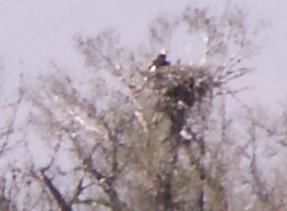
The other American Eagle, the Bald Eagle (Haliaetus leucocephalus), has become far more common in our area since the banning of DDT in the 1970s. This photo shows one of two Bald Eagle nests we found in Narrowleaf Cottonwoods (Populus angustifolia) along the Green River. Both nests appeared to harbor young bird(s), a few days old. Twenty-five years ago, nesting Bald Eagles here were unknown.
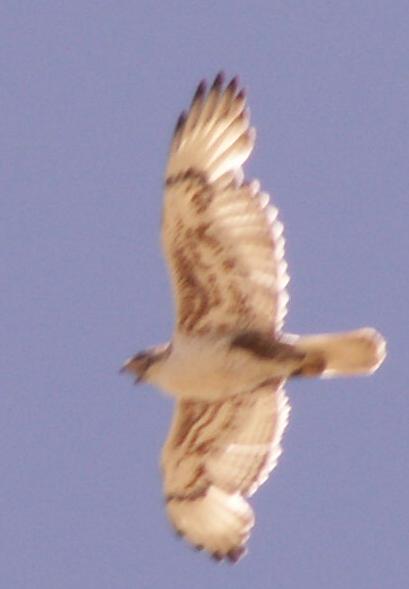
One of my favorite predatory birds is the Ferruginous Hawk (Buteo regalis). This bird is the largest and most powerful North American member of the genus Buteo, and in many ways is more like a small eagle. These spectacular birds are said to prey almost exclusively on mammals, but a friend of mine had a tiercel Peregrine killed by a wild Ferruginous last year. The nests that I've seen have contained mostly remains of groundsquirrels (Spermophilus spp.).
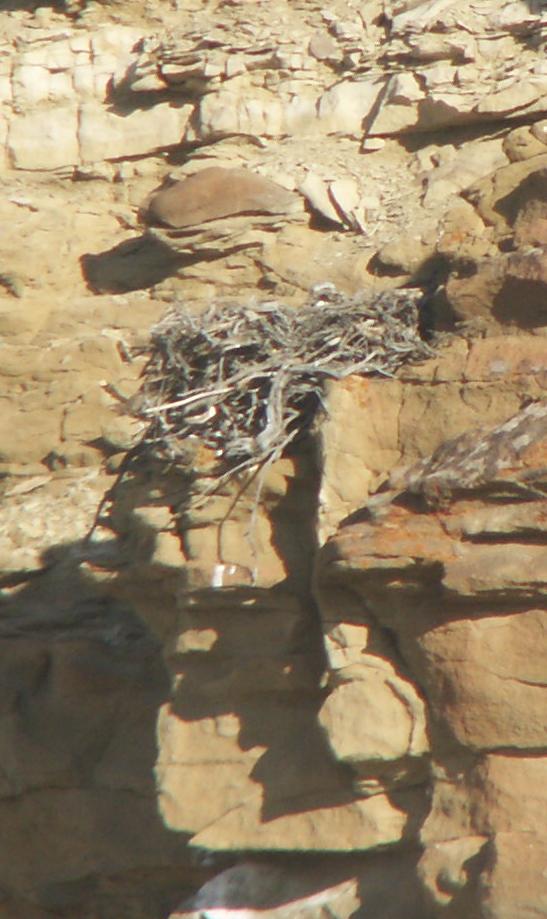
Ferrugies nest both in trees and on cliffs and bluffs. Most cliff nests are situated like the one in the photo (the incubating hen's head is just visible), on the top of a pinnacle--often at the very top of the cliff. Many of these nests can be walked right up to. I've even seen some that were built atop a simple knoll, with no cliff involved. A pair near Farson built a nest this year on top of a haystack. Incubating Ferruginous Hawks are very easily stressed, and their nests should never be approached before the eggs have hatched.
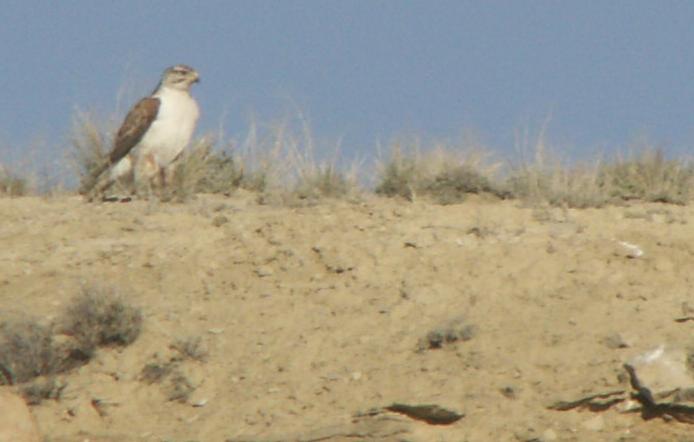
In the Utah deserts, Ferruginous eggs usually hatch around the beginning of May. Up on the Anticline, it's usually a month later. The hen does most of the incubating, and the tiercel provisions her. He'll spend most of his time sitting at the top of a cliff, within sight of the nest. This year, Ferrugies are nesting in close to maximum density. I found five cliff nests, one big tree nest with a very dark hen incubating, and that haystack nest. In a week or so, I'll probably go back up to watch some eyries from a blind, just because I love these birds so.
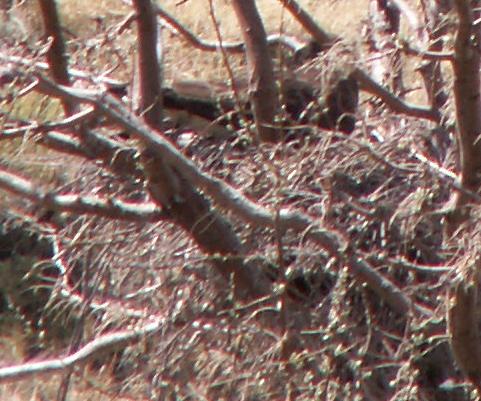
Swainson's Hawk (B. swainsoni), a relative of the Ferruginous, is another (I believe) beneficiary of the DDT ban. Today they are abundant in the Intermountain West, but in the '70s they were quite rare. I expect their largely insectivorous ways made them susceptible to DDT when that chemical was used widely in American agriculture, though I know of no studies to back this up. These slim, long-winged birds are perhaps the most variable American buteo. The typical adult has a white throat and belly, separated by a dark breast band. The pale wing linings contrast strongly with dark flight feathers. A bird that looks like this is easy to identify, but many individuals deviate wildly from the standard pattern. Some birds even lack the dark flight feathers, and, to confuse the issue further, some sport quite red tails. This incubating hen is uniformly dark. The best diagnosis for the bird is its distinctive slender build, erect posture and its long, thin wings. The photo shows one of two Swainson's Hawk nests I saw. The other pair had not yet layed eggs. Microecos has a very good recent post on this interesting bird.
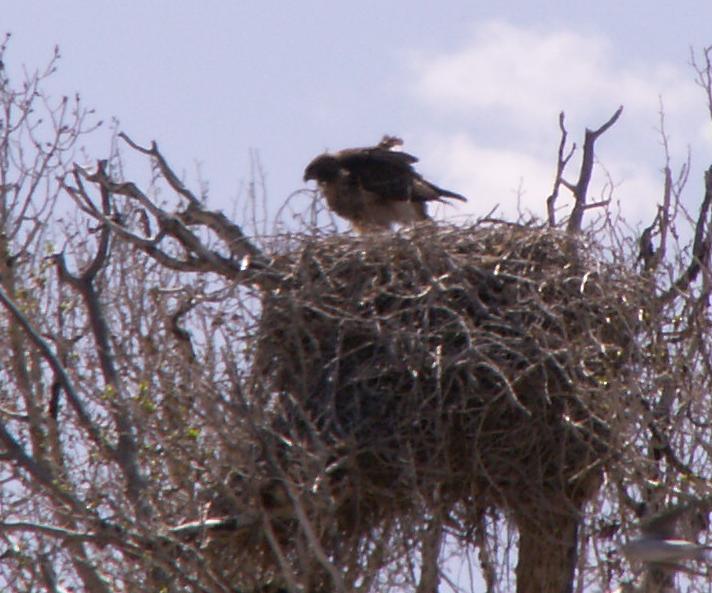
The best-known American buteo is the Red-tailed Hawk (B. jamaicensis), and it's as healthy on the Anticline as anywhere else. I found six nests of this generalist on my last trip to the Anticline: three in trees, three on cliffs. All of them appeared to have very small young.
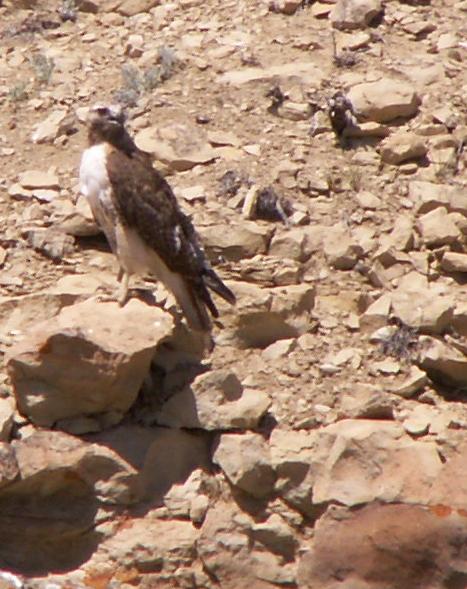
A particularly goofy-looking hen.
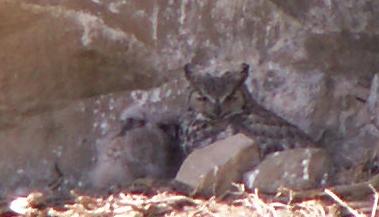

Great Horned Owls (Bubo virginianus) are the only owl species I've seen on the Anticline. Here the hen roosts next to her three young birds in an abandoned Golden Eagle nest. I'm surprised to have never seen a Short-eared Owl (Asio flammeus) or even a Long-eared (A. otus). There is plenty of what passes in my eyes as good breeding habitat for the former species and good winter habitat for the latter, but I've never seen or heard either up here. I'm also a little surprised to have never seen or heard a Poor-will (Phalaenoptilus nuttalli) up here, either. It's probably just a bit too cold for any of these birds. I imagine that Screech Owls probably haunt the riparian areas, but I've yet to confirm that.
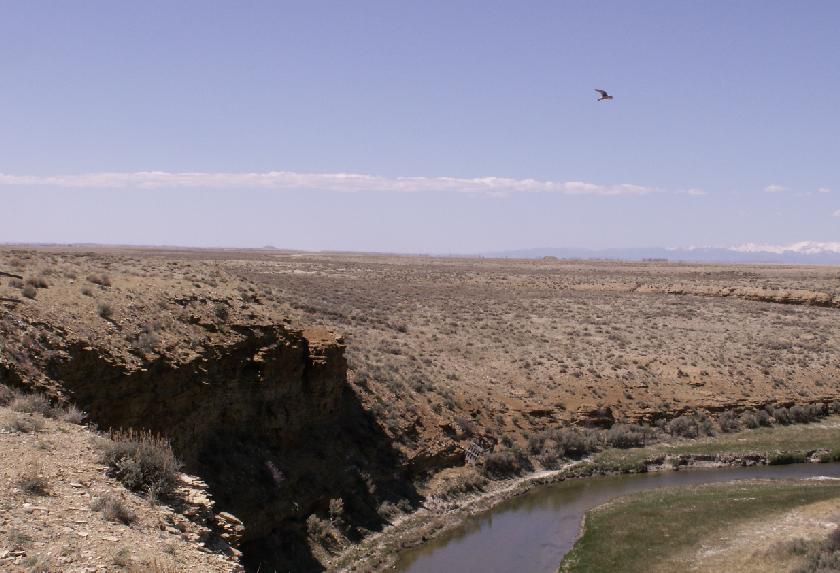
Last of all is the Prairie Falcon (Falco mexicanus), a bird that is, to me, nearly as iconic of the region as the Sage Grouse. We found six Prairie Falcon eyries (in this photo, the tiercel scolds us, while the falcon incubates). These birds are close to the size and build of a Peregrine (F. peregrinus), but are not as wedded to birds as are their more widespread cousins. Prairies will take a wide range of prey. The other day I watched a tiercel snatch a chipmunk (Tamias sp.) from the valley floor, and haul it off to his waiting mate, harried the whole while by a much larger Swainson's Hawk. The Utah desert Prairie Falcons are fledging now; in the mountains they're all hatched (the early mountain eyrie I posted about earlier this year fledged two weeks ago), but Prairies on the Anticline are all still on eggs.

It's nice to be able to report such positive ecological health from this area. The density of raptor nests was staggering. Many nests were just a hundred yards or so apart. The Swainson's Hawk nest pictured above was in direct view of nesting Prairie Falcons and Ferruginous Hawks. Kestrels (Falco sparverius), and Marsh Hawks, or Northern Harriers (Circus cyaneus) were fairly abundant, and I saw an Osprey (Pandion haliaetus) and a possible Merlin (Falco columbarius). I'll wrap this little series up in part iii, which will cover all the stuff that isn't a raptor or grouse...well, okay...some of it.
_____________________
All photographs in this post were taken by CPBvK on the Pinedale Anticline, May 15-17, 2006

Tuesday, May 30, 2006

CIRCUS OF THE SPINELESS UP AT BURNING SILO


The ninth edition of Circus of the Spineless, the invertebrate blog carnival, is up at Burning Silo. This is the most interesting time of year to be outside, and I've really been slouching on my blogging duties, not to mention housekeeping. I wish I'd posted something appropriate in the past month to send Bev, because this edition seems to be especially good.

Saturday, May 27, 2006

VANISHING CIRCLES

In an earlier post I covered my acrylic painting technique in a step-by-step demonstration of the painting of a Desert Tortoise (Gopherus agasizii). The painting was commissioned for Vanishing Circles, a project for the Arizona-Sonora Desert Museum in Tucson, Arizona. At the time, I promised to post more about the Vanishing Circles project, and it's taken me until now to actually do that. Vanishing Circles is the brainchild of Priscilla Baldwin, a trustee of the Museum. About the project, she says:

"It is a collection of paintings depicting the threatened and endangered species and places of the Sonora desert area. This includes the southern part of Arizona, The whole of Sonora, Mexico, the Sea of Cortez (Gulf of California) and most of Baja California. Places as well as species are included because species are endangered for the most part due to what is happening to their habitat.

"This collection, which I hope will become a book and a traveling collection, is intended to bring attention to these species and their predicament in the world today. I am hoping that this collection will be a role model for other institutions to use art to further their and our efforts to conserve and preserve the world we live in today. Also, if a species does become extinct in the future, we will have an accurate recording of that species and information about it which is current for today.

"I just learned that the national botanical illustration organization wants to start a collection (for tour) of threatened and endangered plants. They, however, are not confining this collection to one region as I have done with Vanishing Circles. I believe they have learned of the idea of Vanishing Circles and changed it to fit their criteria, as I have asked some of their members to do the plants that are threatened in the Sonoran desert region. This is exactly the kind of event that I had hoped would happen as I cannot do it all, but other organizations in other regions of our country can bring attention to the threatened species in their region."


I'm currently at work on a Mexican Beaded Lizard for the collection. This is a particularly enjoyable task for me, after having worked closely with my old pal Dan Beck in illustrating the cover for his fabulous book, Biology of Gila Monsters and Beaded Lizards.

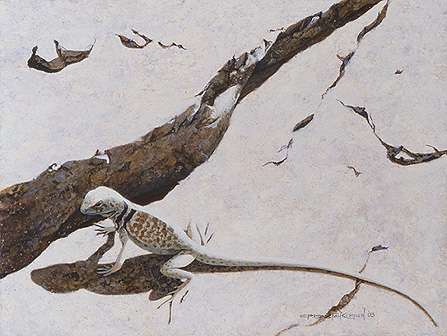
Before the tortoise and beaded lizard, I painted a pair of interesting lizard species for Vanishing Circles. The San Esteban Chuckwalla (Sauromalus varius), a cousin of the well-known Common Chuckwalla (S. ater=obesus) of the American Southwest, is found only on three small Islands in the Gulf of California: San Esteban, Roca Lobos and Pelicanos. Also known as the Piebald Chuckwalla, Painted Chuckwalla, or Giant Chuckwalla, this species can top two feet in length, making it by far the largest member of its genus, and a textbook example of insular gigantism, the tendency of small animals to increase in size once they're established on an island. In 1964, J. Bristol Foster published his Island Rule, which essentially states that larger creatures are more vulnerable to capture by predators, and on an island, where terrestrial predators are often lacking, small creatures tend to grow large, and fill new niches, while large creatures tend to become smaller, and less of a burden on limited food resources. Foster's Rule has been ammended and fine-tuned by Robert MacArthur, E. O. Wilson, Ted Case and others, but its basic principles are still generally accepted. An interesting contemporary example of insular gigantism is taking place on Gough Island, in the South Atlantic, where introduced House Mice (Mus musculus) have tripled in size in just a few decades. The giant mice prey on seabird chicks. Because of its extremely limited habitat, the San Esteban Chuckwalla was listed as an endangered species in 1980. The Arizona-Sonora Desert Museum maintains a sizeable colony of these reptiles, and has been responsible for a great deal of important research on the species.

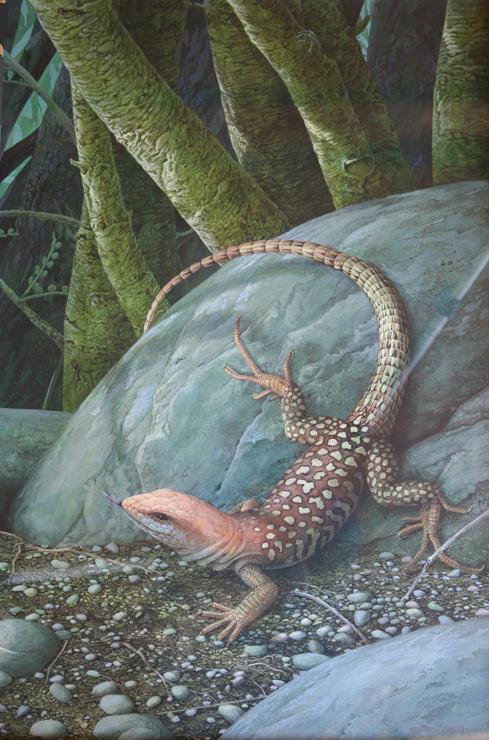
The Giant Spotted Whiptail (Cnemidophorus burti stictogrammus) is another giant lizard restricted to a few small locales. Although it has a larger range in the Mexican state of Sonora, its US range is restricted to the Pajarito, Santa Catalina, Santa Rita, San Luis and Baboquivari Mountains, and part of the Santa Cruz River Basin of Arizona, and Guadalupe Canyon in southwestern New Mexico. Presumably, the lizard was formally distributed throughout the region. It's not clear why it died out in most of its American range, leaving these few disjunct, relict populations. It's thought to have been extirpated by human development in the Tucson Basin and the Santa Cruz Basin between Tucson and Nogales. At a length of as much as a foot and a half, the Gaint Spotted Whiptail is by far the largest whiptail found in the U.S., although other large members of its genus are found south of the border, and its South American cousins the tegus (Tupinambis spp.) and Caiman Lizards (Dracaena spp.) can exceed a yard in length. The taxonomic designation of the Giant Spotted Whiptail has been the subject of some controversy. It has usually been considered one of four subspecies of the Canyon Whiptail (C. burti), two of which occur in the U.S., two in Mexico, but some authorities prefer to conflate it with the Mexican species C. sacki, and there is a growing school advocating full species status.
_____________________
upper: SAN ESTEBAN CHUCKWALLA (2005) acrylic 30" x 20"
lower: GIANT SPOTTED WHIPTAIL (2006) acrylic 30" x 20"

Thursday, May 25, 2006

I AND THE BIRD #24


.........hawk owl's nest...................wild bird on the fly
..............................................thomasburg walks
..invasive species weblog.................living the scientific life
...........birdstuff
...........woodsong.............................10,000 birds
.....bird brained stories..................science and politics
.....biology in a digital world..............elms in the yard
.......journey through grace..................peregrine's bird blog

..............The House.......................charlie's bird blog
.......search and serendipity.................ben cruachan blog
..........ratty's ghost..........................a dc birding blog
.............migrations........................ocellated
......aimophila adventures..................natural visions
...............microecos.........................earth, wind & water
Postscript: Every spring there's a straggler or two, even on the internet. This season's straggler of note is the Pigeon Guillemot (left i on the news).

Wednesday, May 24, 2006

CARNIVALERT #5

Tangled Bank is the blog carnival of the Life Sciences. Edition #54 is up on Science & Politics, where it will be Coturnix' last carnival before moving to Scienceblogs. There are lots of fascinating posts there. I intend to go back when I get some time to read them all.
I and the Bird will go up tomorrow morning right here. Gotta get back to work and make sure that happens. See you then.

Tuesday, May 23, 2006

LAST CALL FOR CARNIVAL!

It's your last chance to be included in the next edition of I and the Bird, the carnival for birds and the people they attract. Send the URLs for your bird-oriented posts to CARELBvK at GMAIL dot COM by tonight (best to get them in before 9pm Mountain Daylight Time). The carnival will be posted right here on Rigor Vitae Thursday morning, May 27th. Be here or be squeer.

Monday, May 22, 2006

IN COLD BLOOD

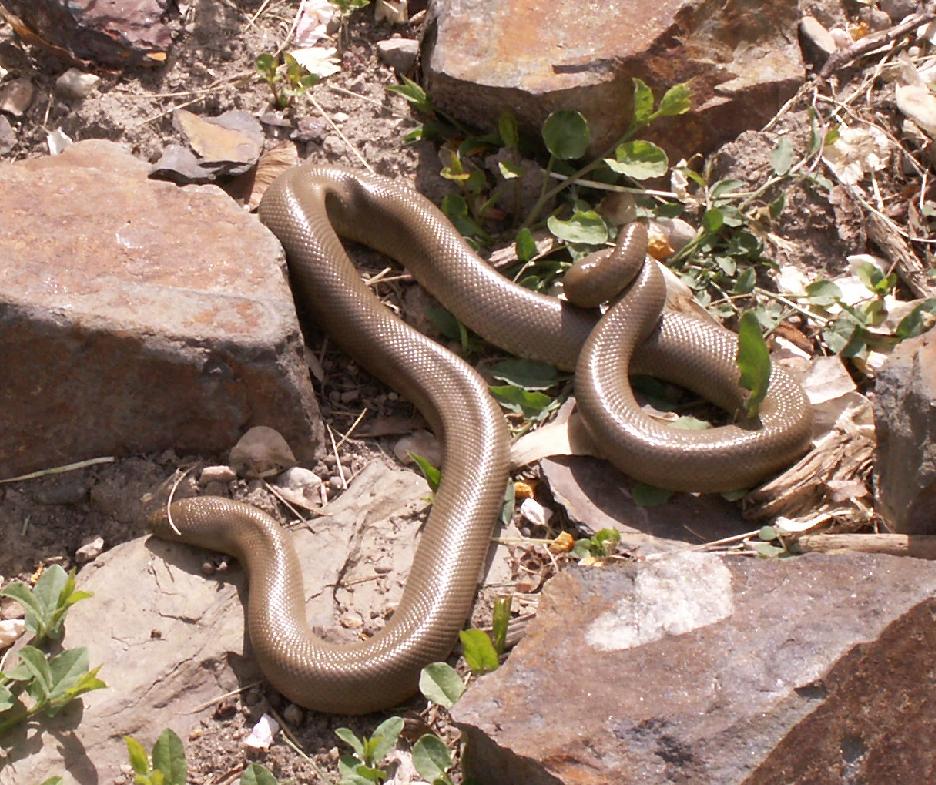
Last week I hiked along a pallid limestone trail by the light of the moon. I was just beyond the 7,000 foot lower elevation limit for Douglas-fir (Pseudotsuga menziesii), and hiking in comfort mandated the donning of a second sweatshirt. The air temperature was just a few degrees above freezing, so I was more than a bit surprised to see a snake crawling along the stony soil. It was a big Rubber Boa (Charina bottae), about 30 inches long. I have hiked in these mountains all of my life, and have caught only a handful of these interesting snakes. Thinking over my previous captures, it occurs to me that they all took place during abnormal cold snaps. I never realized it before, but it appears to me that the ideal body temperature for Rubber Boas must be extremely low.

It's a gross oversimplification to describe animals as either “warm-blooded” or “cold-blooded,” since there are a multitude of techniques creatures use to thermoregulate. When driving through the country in the morning or evening, it's common to see lizards and snakes stretched out on the warm pavement, often permanently. This is the sort of behavior we normally think of when considering reptile thermoregulation, but for animals like the Rubber Boa, life is more of an exercise in avoiding heat than seeking it. A number of reptiles function best at low temperatures. A little rattler called the Midget Faded Rattlesnake (Crotalus viridis concolor) is rather common in the eastern part of Utah, and is also only seen on very cool nights. In Florida, Indigo Snakes (Drymarchon corais) spend the summers deep underground, emerging only when cold weather drives the other resident snakes beneath the surface. The relictual Tuataras (Sphenodon punctatus) of New Zealand are the most cold-blooded reptiles of all, with an optimum body temperature of around 10ºC (50ºF). Amphibians tend to have lower optimum body temperatures than reptiles.
Reptiles, amphibians, and other animals that are poikilothermic (meaning their body temperature varies with the ambient temperature) can raise their temperature in ways more sophisticated than simply basking on a rock. Muscle contractions release heat, and movement is often used in thermoregulation. Sphinx moths (family Sphingidae) vibrate their wings on cool evenings in a pre-launch warm-up. As an animal increases in size, its surface area-to-volume ratio decreases, and heat loss slows down. A boxy, half-ton Leatherback Turtle (Dermochelys coriacea) can increase its body temperature significantly simply by swimming. This is assisted by heat exchangers in the reptile's circulatory system. Such devices are also present in some sharks, and are most highly-developed in tuna of the genera Thunnus and Katsuwonus. These fish can maintain a temperature in the swimming muscles of their upper tails about 14ºC (25ºF) higher than the ambient water temperature. The veins and arteries inside the muscles branch into tiny intertwining vessels. As it passes through the body, heat diffuses from the muscle-warmed blood in the veins into the cold, oxygenated arterial blood.

We tend to think of poikilothermy as being limiting, but it's not without its advantages. Our constantly-burning metabolic furnaces are expensive to run. A lizard or snake can devote practically all of its energy to the business of foraging and reproducing, and has no need for all the extra food required for metabolic thermoregulation. Because of this, poikilotherms tend to me more plentiful; a given parcel of land can support far fewer weasels, for instance, than carnivorous reptiles of similar size.
One of the downsides of poikilothermy is the fact that internal chemicals often react differently at different temperatures. Reptiles tend to need lots of redundant chemical systems to function properly at different temperatures. Aside from this, though, the advantages of a steady internal temperature are often exaggerated. I can't speak for other homeotherms, but I probably work at least as hard at keeping myself surrounded by a favorable ambient temperature as your average Rubber Boa does, and it's not a bit unusual to find me stretched out, enjoying the heat of a nice, flat rock.
_____________________
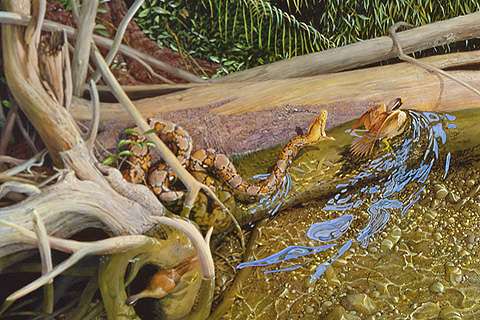
upper: RETICULATED PYTHON & MASKED FINFOOT (1999) acrylic 20" x 30"
center: Rubber Boa Photograph by CPOBvK, May 16, 2006
lower: BASKING BAJA CALIFORNIA COLLARED LIZARD (2003) acrylic 9" x 12"

Thursday, May 18, 2006

A PINEDALE ANTICLINE PHOTOJOURNAL--Part I: The Grouse

As a follow-up to my earlier post on the politics of energy extraction and conservation on Wyoming's Pinedale Anticline, I offer this report from a recent visit to the region with my friend, Steve Chindgren, who probably understands Sage Grouse (Centrocercus urophasianus) better than anyone.

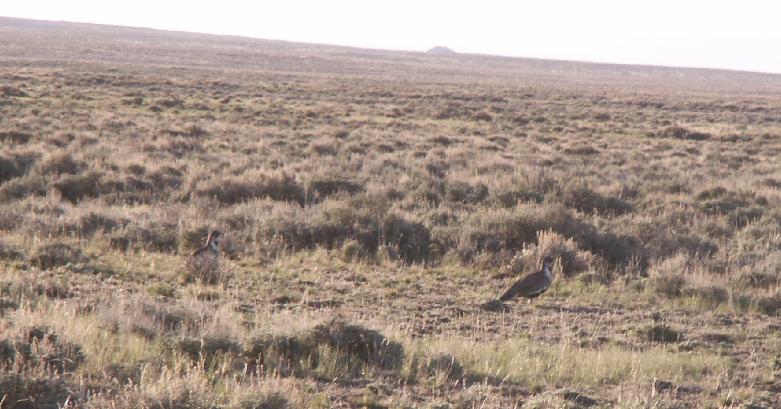
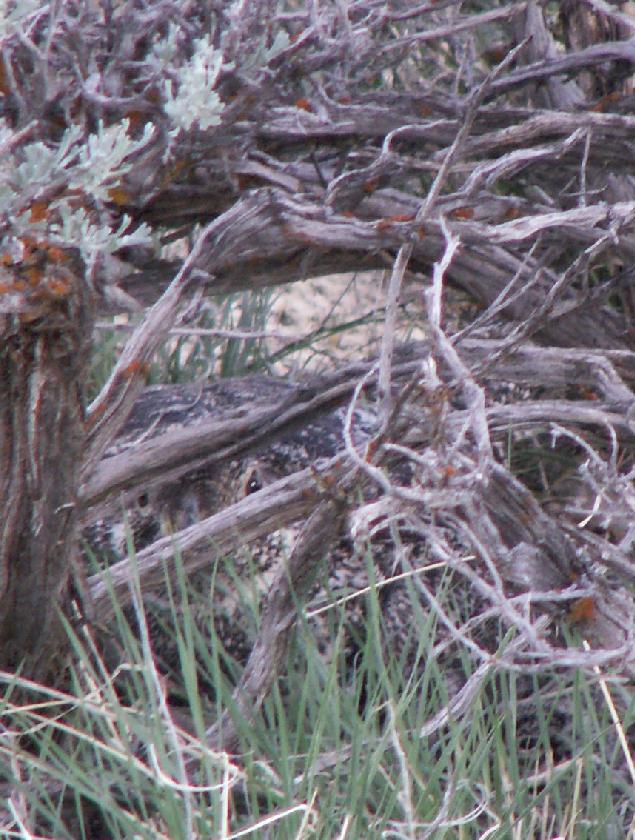
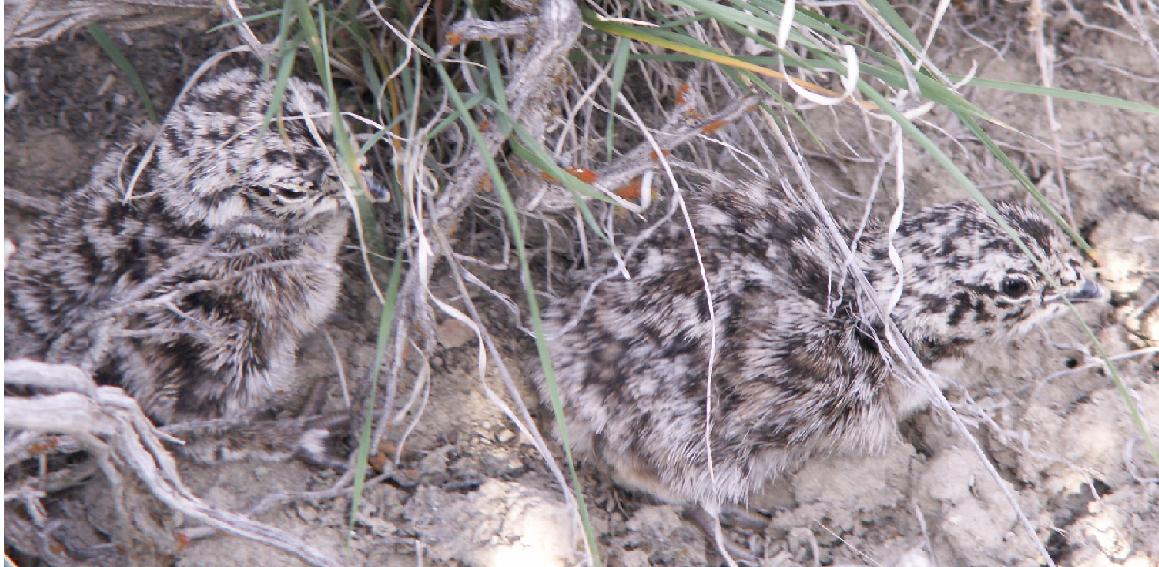
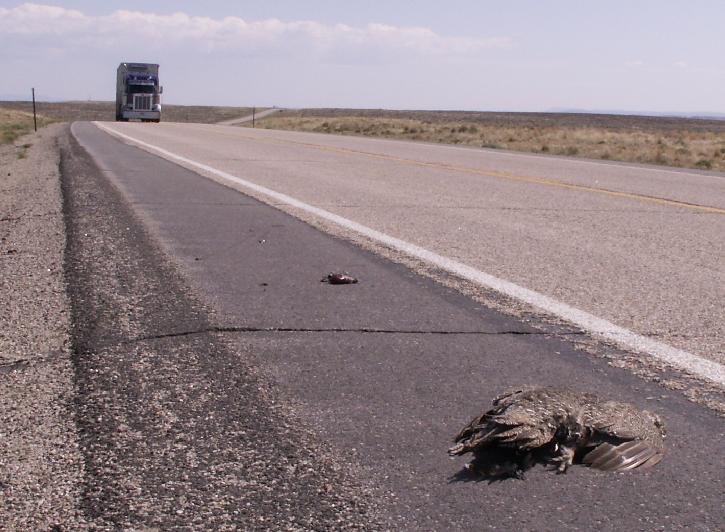
With an average 60 frost-free days per year, spring comes late to the Anticline, but it is has most certainly arrived. This week midday temperatures soared up near 80ºF. The spectacular lekking displays of cock Sage Grouse are little more than a memory.May 16, 7:00am: A month ago more than 200 cocks displayed on this lek. Now, just a handful of desperate birds loiter unenthusiastically after having strutted the previous night away. Strutting hours are strictly enforced by the grouse's chief predator, the Golden Eagle (Aquila chrysaetos), which doesn't begin hunting until the sun has warmed it. When the moon is full, the grouse take full advantage of eagle-free hours, and display through the night. All of the self-respecting hens are nesting now, and only ones that have already lost their eggs will visit the leks this late, trying for a second shot. At the peak of the season, fertilization of the hens is done by a tiny minority of cocks. Whether these late lekkers represent alpha birds or some other demographic has yet to be established.This lone hen has probably just lost her clutch of eggs. Soon she will group up with other lone females to visit what small leks are still active, then attempt a second nesting. Sage Grouse are very social birds, and they winter in huge mixed flocks. As the strutting season begins in February, the sexes segregate. Once bred, the hens beome solitary for the nesting season. Through the summer they will lead their chicks through good foraging areas, and in the fall the birds will regroup to head for the wintering grounds. Ravens (Corvus corax) are presumed to be the most important grouse egg predators, but practically nothing is known of the causes of nesting failure, since Sage Grouse nests are so incredibly hard to locate.To find a Sage Grouse nest, knowing a bit of scatology is helpful. Ordinary grouse droppings look like the ones on the left, a pile of buffy pellets. The density of these pellets can give important clues to the kind of grouse behavior that has taken place in a given spot. Incubating hens undergo a metabolic change. They defecate but once a day, producing a single groaner of a scat like the one on the right. Discovering one of these means a nest is within about fifty feet. The pattern of the Sage Grouse hen's back looks precisely like the shed leaves and twigs beneath a sagebrush, so even after finding a groaner, a couple of hours of careful searching are invariably required before the nest is located. The incubating hen sits close, flushing only when practically touched. Here a brooding hen faces the viewer. Click on the photo, and look carefully in the lower-right corner. The face of a chick, a couple of hours old, is visible. The young birds move under their mother, or away from her, depending on the ambient temperature. On a warm day like this one, even very young chicks will sit around the hen rather than underneath.Usually six to eight spotted, khaki-colored eggs are laid in a grass-lined depression under a sagebrush. Once the last egg is laid, incubation begins, which takes just under four weeks. Last summer was unusually wet on the Anticline, so breeding success of wildlife in general was very high. Despite the fact that it hasn't yet rained this spring, bird clutch sizes are above average. Here, a clutch of nine eggs is caught in the act of hatching. Of the nine eggs, one failed to hatch, and one chick died just after hatching. Sawing an eggshell apart requires a lot of energy from a chick, and a death at this time is not unusual.Within an hour, the chicks are dry and able to move about. They are extremely beautiful little birds, and their cryptic color pattern blends in perfectly with the dried grasses and shed sage leaves. This chick, about an hour and a half old, sits beside its mother.Once the chicks are five or six hours old, they have the strength to run about. The family will now leave the nest for good. As the young birds age and the weather warms, they will spend less time being brooded by the hen, who will lead them to moister areas with lots of young plant growth and small insects. As they grow up, invertebrates will make up an increasingly small portion of the omnivorous chicks' diet. By the first snow, all the birds will sustain themselves solely on sagebrush leaves (in the summer adult birds aren't at all above eating a bug or two, and I've watched them gorge themselves on Mormon Crickets [Anabrus simplex] when those insects are abundant). Of the seven chicks that left this nest, most will not survive the summer. A hen that produces two offspring that make it through to spring can be considered very successful. Once a bird is a year old, it is far less vulnerable to the ravages of nature. Aside from Golden Eagles, not many predators are capable of catching and killing one of these big, powerful and very fast-flying birds.Automobiles are as big a threat to Sage Grouse as they are to any wildlife. In the summertime, hens are particularly vulnerable, as the runoff from highways produces lush little bands of tender grasses and insects on either side, luring mother birds to lead their broods to their possible demise.
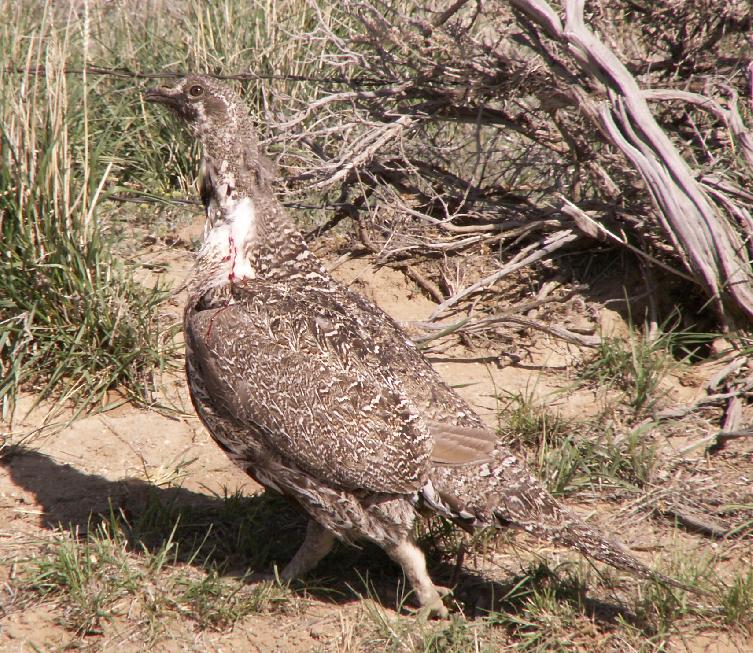
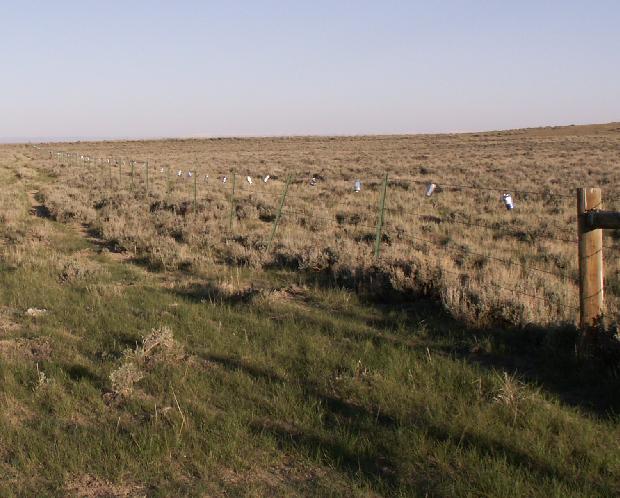
Fences pose a less obvious but far greater hazard than highways. This cock has clearly had a collision with the barbed wire fence behind him. Blood can be seen trickling freely down his neck. From here, he walked off into the sagebrush, reluctant to fly. Whether this was because he was unable to or because he chose not to out of simple soreness is hard to say. Sage Grouse are powerful fliers that often move just over the sagebrush tops at speeds as high as 70 mph. At such velocity, a single strand of wire is very hard to see, and deadly to hit. Fences that cross popular flyways take out a high number of birds. Last year Steve and I counted an average of 15 dead grouse per mile along one stretch. This represents but a portion of the birds that perish, since many of them are not killed immediately, but wander off to die elsewhere. Coyotes learn to walk the fencelines, and they drag away many grouse carcasses. Last summer, Steve and I wired beer cans that had been donated by the local bar in Farson to this stretch of high-mortality fence. This year we did not find a single dead grouse along it--a simple solution to major problem.Overall, the Pinedale Anticline is very healthy. Last year's wet weather was good for the vitality of the system, and wildlife is abundant. This year's dry weather does not bode well for the short-term, and I don't expect it to be as good a summer for anything but the scavengers. Nothing abnormal here, though--this is a harsh ecosystem, full of tough residents that have dealt with worse for thousands of years. In part two we'll look at some of those other Anticline denizens.
_____________________
All photographs in this post were taken by CPBvK on the Pinedale Anticline, May 15-17, 2006

I AND THE BIRD TO STOP BY NEXT WEEK

Just a quick reminder that Rigor Vitae will be hosting I and the Bird, the bird blog carnival, one week from today. Be sure to drop by for the festivities. Please bring something to share, as well--in the form of your own submission. Send a link to your bird-oriented post to CARELBvK at GMAIL dot COM by 9pm Tuesday night, May 23rd. Early submissions are appreciated and will be rewarded.

Saturday, May 13, 2006

MONKEYS IN THE NEWS

Most primates are big, conspicuous animals. They're often very hard to observe in a thick forest, but they're usually noisy and social, and tend to leave a lot of evidence of their presence. So it's always a bit exciting when a new species is discovered, like the Arunachal Macaque (Macaca munzala), discovered in the northeastern Indian state of Arunachal Pradesh two years ago. Madagascar has yielded as many as six new species of lemur in the past few years, but the last new primate genus, as far as I know, was named in 1923 for the monotypic Allen's Monkey (Allenopithecus nigroviridis) of Central Africa.

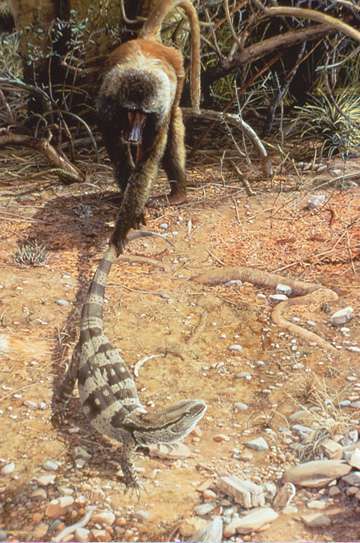
The last institution I'd expect the identification of a new primate genus from is probably the University of Alaska, but they've released the word that that's exactly what they've done. Last year the discovery of a new monkey was announced from the mountains of western Tanzania. Thought to be a species of mangabey (Cercocebus spp.), it looks very much like a member of that genus (see photo below), in fact, many authorities were not convinced that it represented a new species. Samples from a dead specimen were sent to the lab in Alaska, where it was discovered the animal was more closely related to the baboons of the genus Papio (see painting above). The monkey has been christened Rungwecebus kipunji, after Mt. Rungwe, where it was found. (Thanks, Afarensis.)Just another reminder of how much we still don't know about the world around us. It was only 14 years ago that a new genus of ox, Pseudoryx, was found in the mountains near the Viet Nam/Laos border. These surprising events make the news, but very few of us hear about the dozens of new frogs, fish, shrews, bats and other less conspicuous critters that are identified each year--and the invertebrates--not even the experts can keep up with the new invertebrates.
Moving from the exciting to the ridiculous, a vaguely related new study finds that alcohol affects monkeys in ways similar to humans. Anyone who thinks this is news should take a look here and especially here.
_____________________
upper: GRIPPING TAIL--YELLOW BABOON & WHITE-THROATED MONITOR (1994) acrylic 30" x 20"
lower: Photograph of Rungwecebus kipunji by Tim Davenport

Friday, May 12, 2006

THE OLD STOMPIN' GROUNDS

I grew up in Emigration Canyon, in the Wasatch Mountains, east of the Great Salt Lake Valley. In 1847, Brigham Young and his Mormon entourage followed the canyon to the Promised Land, and since there were no canyons leading out of Nauvoo, Illinois (their point of departure) to give the name Emigration to, they gave it to ours. A small working-class community clung to a six-mile stretch of State Highway 36, which runs through the canyon. It was an ideal place for a boy with an interest in nature to grow up, with a limitless expanse of wilderness to explore. A horse trail followed a long secondary valley to the north of the canyon, and this was our access to the richest back country. The land belonged mostly to the BLM or to one of two sheep-ranching families whose younger generations were already looking to other occupations by the time I was born. Sheep were summered in the canyon for the last time in 1970, and within a decade, housing developers with dreams of dollar signs began buying up their land.

Today that horse trail is a two-lane paved road lined with hundreds of enormous homes and manicured yards. Twenty years ago, the powerful aroma of sagebrush and balsam-root were striking, but today they are completely masked by the perfume of chemical fertilizers. The road follows roughly the same course as the old horse trail, and I've continued to use it to access the back country each year.
On my last trip, though, at least one resident was disturbed to see a man with a backpack walking up the road under his own power, and called the police. Deputy Sheriff Kyle Lowther was dispatched to solve the problem, but unfortunately he arrived after the perpetrator had already disappeared up a deer trail. On my return, just yesterday, Officer Lowther's timing was better. He detained me, explaining that although it was unmarked and ungated, the road was private property, and that I was to leave, and would be jailed if I was caught stealing another hike from the good citizens. Deputy Lowther was actually a very nice guy doing his job, and I got the feeling he understood how ridiculous his task was. He even posed for this nice picture.

Walking back to the highway, I felt indignant, and my gut response was to declare war, but I had no right to be too hard on these newcomers, however distasteful I found their values. My own family tore out a chunk of wilderness to build our house. Each time I hike up there and see another clump of aspens being bulldozed, and drilling mud or chlorinated, softened water being pumped into a creek, I have to temper my anger with the knowledge that the Canyon's blood stains my own hands, too.
I mention this story not only to vent, but to illustrate two factors affecting our ever-changing relationship with the land. The most obvious is the enormous impact that members of a species as chronically successful as our own have with our each move, each decision. We've spent the past 10,000 years trying to hide it from ourselves, but our lives are still irrevocably dovetailed into that vibrating ecological matrix. Our every activity broadcasts a little ripple, and each ripple is amplified by a factor of six billion.

The second factor that comes to mind is the commodification of wilderness. That old maxim, “the best things in life are free” is becoming increasingly fallacious. One of the many drawbacks of a capitalist system is that it rewards and encourages the greedy. As wild country becomes more scarce, the charlatans will move from the woodwork to the woods, trying to find a way to sell it to us. What disturbs me is not so much that the gates of the wild will be closed to the poor, but that the land beyond those gates will be managed with an eye toward profit. The end result will be wildlands that are fit only for the wealthy, and that's a result I can live without.
_____________________
upper: DISCIPLINE--FERRUGINOUS HAWK (1995) acrylic 40" x 30"
center: Deputy Sheriff Lowther, May 11, 2006
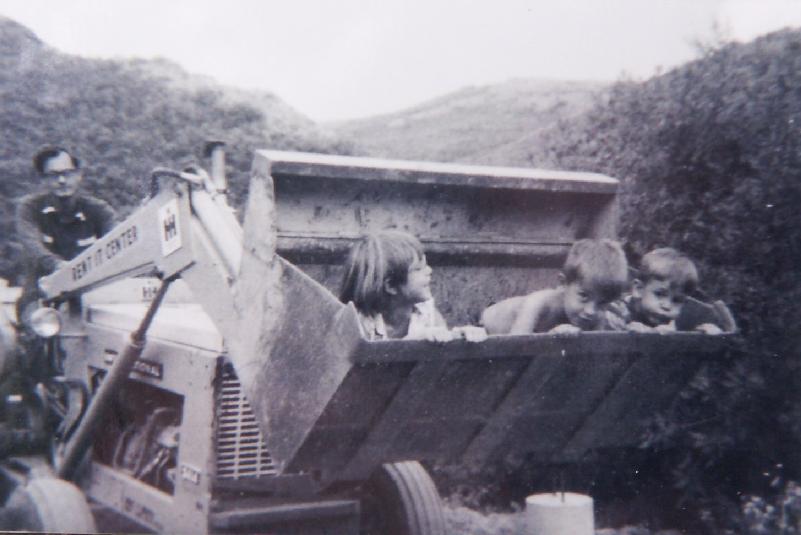
lower: The Brest van Kempens, c. 1965 (that's me in the center of the loader bucket)

MAY I HAVE THE ENVELOPE PLEASE...

"That's not much of an envelope!"

"Not much of an entry."

For those who don't know, BIRDS IN ART is the premier annual exhibition of Bird Art. Hosted by the Leigh Yawkey Woodson Art Museum in Wausau, Wisconsin, the submissions of artist from all over the world are winnowed down each spring to 100 works of art, which will be installed at the museum in the fall. A selection from that show will subsequently tour for about 14 months. In early May, nature artists check their mail boxes, hoping for the "big envelope," filled with forms to be filled out and sent back to the museum, and not the "little envelope," which contains the single Dear John letter.

I've faithfully submitted to BIRDS IN ART every year since 1989, and believe I may have established a new record. Last night I retrieved from my PO box my 14th BIA rejection for the little fellow pictured above.

So how about you? Which envelope did you get?
_____________________
illustration: CRASH-BARRIER WALTZER--BLACK-BILLED MAGPIE (2005) acrylic 30" x 22"

Wednesday, May 10, 2006

CARNIVALERT #4

The 53rd edition of TANGLED BANK, The carnival of Life Sciences is up at Science Notes. Strap on your climbing irons and enjoy 23 fine posts about medicine, genetics, paleontology and other fields.

Edition #23 of I and the BIRD, the birder's blog carnival, is now up on Bird DC. Nick has created a wonderful bird identification quiz. I'm still convinced that some of those pictures are of bits of candy-bar packaging. Be sure to take it, it's a lot of fun, and you're sure to score better than my paltry 16! I'll have my revenge on Nick for my public humiliation on Thursday, May 25th, when I and the BIRD is hosted right here at Rigor Vitae. Be sure to submit your URLs to me for that one, identified with a subject heading of "I and the Bird." Send them to CARELBvK at GMAIL dot COM by 9pm mountain daylight time on Tuesday, May 23rd. This carnival will involve a bit of extra work for me, so early submissions will be appreciated (I've got a lot of nerve to request such a thing, after sending my own I and the Bird submission at the 11th hour last night--Nick, you've got a late entry pass).

MASTERPIECES IN MINIATURE, The annual spring miniature show at Picture This! Gallery in Sherwood Park, Alberta opened last weekend, and continues through Thursday, May 25th. The public drawing for intents to purchase will take place on that evening, at 7pm.

Tuesday, May 09, 2006

GOLDEN EAGLE NESTS

Last week I found a new eagle eyrie. At least I think I found a new eagle eyrie. It sits toward the top of a low cliff, about 25 feet up. No birds were visible through the binoculars, nor whitewash on the rock face below, but a tell-tale lining of green leafy twigs confirmed that the nest is in use. Brooding Golden Eagles (Aquila chrysaetos) are shy birds, and the adults usually slip off the nest before they can be seen. Their closest relative in these parts, the Ferruginous Hawk (Buteo regalis), is often nearly as bashful, and a nest in this situation could belong to either bird. Once I'm sure the egg(s) have hatched, I'll move in for a closer look.

Five years ago I found a nest in a similar site, that could have belonged as easily to a Ferruginous as a Golden. It was late May, and I hiked up to the cliff to inspect it. I had to climb the cliff several yards to the east of the eyrie site, then traverse across a ledge. As I closed in, I saw a dark body feather stuck to the rock face. I was disappointed; I had hoped for Ferrugies, whose feathers are paler. Once I reached the feather and saw its glossy blackness though, my disillusion became complete. It was a raven feather. They've taken over an old eagle nest, I thought. Creeping across the cliff a bit further, I suddenly found myself face to face with a single fat tiercel Golden Eagle chick. The nest and the rocks below were littered with dozens of raven wings. This eagles' parents had developed an usual specialty.

A Golden Eagle nest usually contains ample evidence of its occupants' diet. The young birds are well provisioned, and it's typical to find a big fresh Jackrabbit (Lepus sp.) in a nest, along with the mummified remains of many previous meals. In fact, this might explain why Goldens are so secretive around the nest. Raptor nests are usually quite easy to find. Red-tailed Hawks (Buteo jamaicensis) will usually start circling 30 feet over your head once you get too close to the nest, giving that beautiful scream, kyee-eer! The intensity of their displeasure is easy to gauge, and they'll lead you straight to the nest in a game of warmer and colder. This is typical of birds of prey, but the Golden Eagle, the one raptor capable of mounting a seriously intimidating threat, invariably sneaks off timidly. As a teenager, I once stole a jackrabbit from an eagle chick and cooked and ate it. Perhaps the Indians of the American West developed similar habits. If humans ever raided eagle nests to the point where they became at all important as competitors with the chicks, the behavior of inadvertently leading humans to their nests would become an adaptive encumbrance and would be dropped. This would also explain why the Golden Eagle is such a highly revered bird in the traditions of practically all the tribes that historically shared its range. I have no evidence to back up this idea, but it's an interesting thought.

Although jackrabbits are the Golden's chief prey, the birds are capable of taking a wide range of creatures. They are the most important predator of Sage Grouse (Centrocercus urophasianus)--morning lekking sessions are invariably broken up by an eagle attack. Anyone who's flown falcons a lot in this area has probably lost at least one bird to eagles. They look slow and sluggish, but much of that is attributable to their size. An eagle moves fewer body lengths per second than a Peregrine, but he can nearly equal that smaller bird in speed. Goldens form close pair bonds, and regularly hunt as a team, and when a pair of them sets their sights on your falcon, there's nothing you can do but stand helplessly and watch.

A Golden Eagle's clutch almost always consists of two eggs, and siblicide appears to be surprisingly common. It seems to me this would tend to decrease the ratio of the smaller, weaker tiercels to hens, but I've seen no evidence of such an effect. Goldens take longer to grow up than any other predatory bird in our region. The incubation period is about 35 days, and the chick's first flight doesn't occur until it is over two months old--more than twice the age of most raptors.

I'm lucky to live in a region that contains fewer humans than any other part of the temperate zone. The Mountain West still enjoys close to a maximum carrying capacity of Golden Eagles, even though I've watched the population of my state more than double in my lifetime. The cliff where I found my first eagle eyrie was recently blasted away in favor of a highway, and each year thousands of acres of eagle habitat are usurped for human pursuits. Ever-expanding McMansion subdivisions and ski resorts bring disturbance ever closer to incubating birds, and the unfortunate new industry of spring helicopter ski trips is destined to become an important eagle threat. For now, though, a 30-minute bicycle ride from my front door can still take me to at least two different eyries, and the sight of those glinting golden hackles is still an unremarkable privelege.
_____________________
illustration: THE SUNNING STONE--GOLDEN EAGLES (1988) oil 24" x 18"

Monday, May 08, 2006

IT TAKES A GOOD EYE TO SPOT A NEW SPECIES

The horned lizards (Phrynosoma spp.) comprise a genus of fifteen or so well-known lizards distributed through most of western North America, from southern Alberta to Guatemala. The entire genus is a pretty uniform lot: small (the giant among them is a Mexican brute of 8 inches), flattened and sprinkled with spine-like scales. The most unusual of the American horned lizards is the Flat-tailed Horned Lizard (P. mcallii), a comparatively slender species that is faster and more active than its congeners, having adapted to survive in the harsh sand dune habitat of the lower Colorado River. This area, where the American states of California and Arizona meet the Mexican states of Baja California Norte and Sonora, is known as the Salton Trough, the lowest and driest portion of the Sonoran Desert. It is the former sea bed of a Pliocene extension of the Gulf of California, and as recently as 500 years ago much of it was occupied by the ancient Lake Cahuilla. For the past century, the lowest part of the lake bed has been inadvertently filled with irrigation runoff, forming the Salton Sea, a 376 square-mile lake that formed the basis for a number of small cities, including Salton City, Salton Sea Beach, Bombay Beach and Desert Shores.

The development of the Salton Trough has diminished the habitat for the few animals that are endemic there, most notably P. mcallii and two species of Fringe-toed Lizard, Uma inornata and U. notata. The last species is listed as a threatened species, the first two are considered species of concern. Today, the range of the Flat-tailed Horned Lizard consists of four disjunct populations, divided by the Colorado River, and by human development around the Salton Sea and in the Imperial Valley. Where the Arizona population abuts the range of the widespread Desert Horned Lizard (P. platyrhinos), individuals that appear to be morphological intermediates occur.

Daniel Mulcahy and colleagues from Utah State University have been sampling mitochondrial DNA from Desert and Flat-tailed Horned Lizards of the Salton Trough region in an attempt to learn not only how long the Flattail populations have been fragmented (and to what degree it was caused by human development), but whether the “intermediates” are hybrids or a discreet lineage. Their results thus far appear in a paper in the latest edition of Molecular Ecology. Although their conclusions will require further sampling to verify, they suggest that the ancestral range of P. mcallii was in the southeast end of the Trough, where genetic diversity is the richest. Two major clades were identified, one on either side of the Colorado River, although at least one unique haplotype was found to occur in both populations. The authors theorize that the lizards entered the region that is now west of the Colorado River during the Pleistocene when the river changed its course and moved east to its current course, leaving Lake Cahuilla to dry. The reptiles then dispersed up the western edge of Lake Cahuilla. The authors believe that the Imperial Valley has been a genetic barrier for the lizards since Lake Cahuilla went dry, but that the populations on either side of the Salton Sea were connected until fairly recently, although the case for this looks less strong to me.The most interesting evidence came from their analysis of Desert Horned Lizard samples. The “intermediate” lizards on the southeastern edge of the Trough appear to be hybrids between P. mcallii and the subspecies P. platyrhinos goodei. It seems from this study, that P. p. goodei, however, represents a lineage distinct from the Desert Horned Lizards, and should probably be regarded as a new species, the Sonoran Horned Lizard (P. goodei). The authors theorize that P. goodei originally derived from hybrids of P. mcallii and P. platyrhinos. This is an interesting example of the utility of comparing your study species with closely related taxa. I would like to see a similar survey done of the Colorado Desert and Coachella Valley Fringe-toed Lizards (Uma notata and U. inornata), which are also endemic to the Salton Trough. It would be interesting to compare the two studies; the two fringetoe species are separated by the same Salton Sea expanse that separates the two westernmost Flat-tailed Horned Lizard populations.
_____________________
upper: DUST DEVILS--DESERT HORNED LIZARD (2005) acrylic 12" x 4"
lower: COAST HORNED LIZARD (1998) acrylic 20" x 30"

Thursday, May 04, 2006

TEN MOST BEAUTIFUL

Ouch!! Cindy at Woodsong has tagged me with the dreaded Ten Most Beautiful Birds meme. Here are the rules as I understand them: I am to post my personal list of the ten most beautiful birds, marking each species I've actually seen in the wild with an asterisk, then tag three other bloggers. Since I can choose my own geographical region, I choose to type locally, list globally.
.........
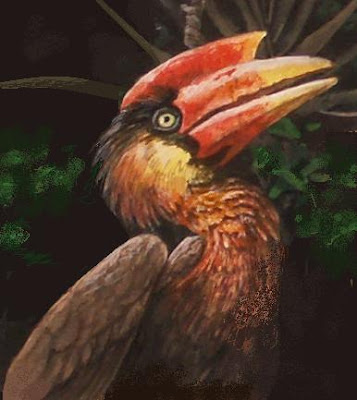
1. I'd be lying if I didn't top my list with a hornbill. Some might call it stretching the definition of “beautiful,” but for me, beauty isn't really complete unless it involves at least a touch of the grotesque, and for downright beauty, the RED-KNOBBED HORNBILL (Aceros cassidix) of Sulawesi has to come in at the top of my favorite bird group. Picking a hornbill denies me the pleasure of listing members from many other favorite related groups: the bee-eaters, wood-hoopoes, kingfishers, rollers, motmots, todies, jacamars, etc. Too bad.2. I have a closer personal association with the falcons than with any other bird group. The athletic, aerodynamic build of the typical falcon is a major component of her beauty, so I was a bit hesitant to list the neotropical APLOMADO FALCON* (Falco femoralis), whose build is the most chicken-like of that august taxon, but her handsome markings more than make up for any other shortcomings.
3. Any discussion of birds' beauty must take song into account. The thrushes are possibly the most beautiful of all avian singers, and no member of that family looks sharper than the palearctic BLUETHROAT* (Luscinia svecica).
4. Choosing between the owls and nightjars was difficult, and once I sided with the latter group, I had to decide whether to score for subtle beauty of pattern, or outrageous ornamentation. Once again, I sided with the latter group, and picked the African PENNANT-WINGED NIGHTJAR* (Macrodipteryx vexillarius).
5. No bird group is more saturated with spectacle than the glittering hummingbirds, and even they don't get much more spectacular than the South American CRIMSON TOPAZ* (Topaza pella)

6. After the hummers, second place in the spectacular competition might well go to the New World tanagers. My pick for most beautiful member of that group is the Andean FLAME-FACED TANAGER* (Tangara parzudakii).

7. I've tried to keep this list as diverse as possible, but it's simply not fair to list but one passeriform bird, since that order contains more than half of all bird species. For outlandish ornamentation in a passerine bird, the award goes to the African PARADISE WHYDA* (Steganura paradisaea).

8. My choice for most spectacular passerine family is the Cotingidae, and, largely because of his incredible blue plumage, the Amazonian SPANGLED COTINGA* (Cotinga cayana) is the last perching bird to make it onto my list.
9. Speaking of colors, the touracos deserve a place on the list just for producing unique red (turacin) and green (turacoverdin) feather pigments. LADY ROSS' PLANTAIN-EATER* (Mussophaga rossae) has no turacoverdin, but I don't think there's a better-looking turaco.

10. Well, I'm already at the end of the list, and if there's a bias so far, it seems to be against water birds. There are lots of beautiful ducks, herons and shorebirds, but I think a Gruiform bird belongs in this final slot. The Stanley Crane came close, as did the Sungrebe and Takahe, but I finally settled on the neotropical SUNBITTERN* (Eurypyga helias).

I beg forgiveness for neglecting the shrikes, birds of paradise, sunbirds, parrots, pheasants, pigeons, toucans, trogons, etc., etc. I'll do my best to make it up to you all in the future. It's time now to move this meme into the next shell out from the hard core of birding bloggers. I hereby tag Coturnix (a list of ten most challenging boxing opponents is acceptable), Lyn and Neil.
_____________________
upper: RED-KNOBBED HORNBILL (2002) acrylic 10" x 9"
second: SMOKE JUMPER--APLOMADO FALCON (1994) acrylic 19" x 30"
third: BLUETHROAT (2002) acrylic 8" x 10"
fourth: SOUTHERN CROSS-PENNANT-WINGED NIGHTJAR (1998) ink wash 23" x 17"
fifth: CRIMSON TOPAZES MOB AN ORNATE HAWK EAGLE (1994) acrylic 18" x 24"
lower: LADY ROSS' PLANTAIN-EATERS (1999) acrylic 15" x 36"

Monday, May 01, 2006

KOSMOS: YOU ARE HERE

DarkSyde, of Daily Kos fame, has just released an exciting new e-book of illustrated science essays by himself, Devil's Tower, and other Kossacks. The introduction is by best-selling science writer Carl Zimmer, and the book is lavishly illustrated by the great Carl Buell and others (including yours truly). Proceeds will benefit Yearly Kos. To find out more, and to order the book, click here.